5 Best Cities in Spain for Expats
By the Resetyl Team · · 11 min read
Spain offers an incredible variety of lifestyles depending on where you choose to settle, and each city has its own personality. For expats in 2026, five cities consistently rise to the top of the list, each for different reasons. Understanding the character of each can help you narrow down where you would be happiest.
Valencia has emerged as the number-one choice for many expats, and it is easy to see why. It combines Mediterranean beaches, a compact walkable city center, and a cost of living that is remarkably affordable for a European coastal city. The tech and startup scene has grown rapidly, making it a hub for digital nomads and remote workers. The City of Arts and Sciences, Turia Gardens, and a lively food scene anchored by authentic paella make it a place where you can build a genuinely fulfilling life. Barcelona remains the glamour pick, offering world-class architecture, nightlife, and culture — but at a higher price point and with more tourist congestion. Madrid, as the capital, provides unmatched career opportunities for those working with Spanish or European companies, plus a cultural depth that is hard to beat: the Prado, Retiro Park, and a restaurant scene that rivals any global capital.
For those seeking a slower pace, Malaga on the Costa del Sol has transformed from a beach-holiday town into a thriving cultural city with a growing international community. The climate is among the best in Europe — over 300 days of sunshine per year — and direct flights to major US cities have made it increasingly accessible. Seville, in Andalusia, offers perhaps the most authentically Spanish experience: flamenco, tapas culture, stunning Moorish architecture, and a warmth of community that expats consistently describe as life-changing. It is also the most affordable major city on this list.
The right city for you depends on your priorities. If you want beach life with affordability, choose Valencia or Malaga. If career opportunities and cosmopolitan energy matter most, Madrid or Barcelona are your best bets. If cultural immersion and a deep connection to Spanish traditions are what you seek, Seville will not disappoint. Many expats recommend spending a month in two or three cities before committing — and with Spain's excellent rail network, exploring is easy and affordable.
1. Valencia: The Best All-Around Choice
Valencia is the city that consistently surprises expats who assumed Barcelona or Madrid would steal their hearts. Spain's third-largest city (population 800,000) sits on the Mediterranean coast, enjoys over 300 days of sunshine per year, and maintains a quality of life that feels effortlessly balanced between beach, culture, and career.
- •Ruzafa — Valencia's hippest district, packed with independent coffee shops, international restaurants, vintage stores, and a dense concentration of young professionals and digital nomads. Rents are rising but still affordable (1BR: 900–1,200 euros). The streets fill with outdoor tables on weekends, and the Saturday Ruzafa market is unmissable.
- •El Carmen — The old town, full of medieval architecture, street art, and nightlife. More tourist-adjacent but deeply charming; ideal for those who want to be in the historic heart of the city.
- •Benimaclet — A quieter, university-adjacent neighborhood with a village feel inside the city. Excellent value (1BR: 700–900 euros), strong local community, popular with those who want authenticity over trendiness.
- •Campanar / Patraix — More residential, ideal for families. Good schools, quieter streets, easy access to everything.
Cost snapshot (single person): 1,400–1,900 euros/month Average internet speed: 450 Mbps (fiber widely available) Estimated expat community size: 35,000–40,000 registered foreigners; significant English-speaking informal community estimated at 15,000+ Coworking options: 15+ dedicated spaces, day passes from 15 euros, monthly memberships 150–280 euros
Pros: Affordable rent, Mediterranean beach 20 minutes from center, excellent food scene, growing tech community, manageable size, easy to meet people Cons: Fewer direct flights than Madrid or Barcelona, smaller English-speaking professional network, some bureaucracy in Valencian language rather than Castilian Spanish
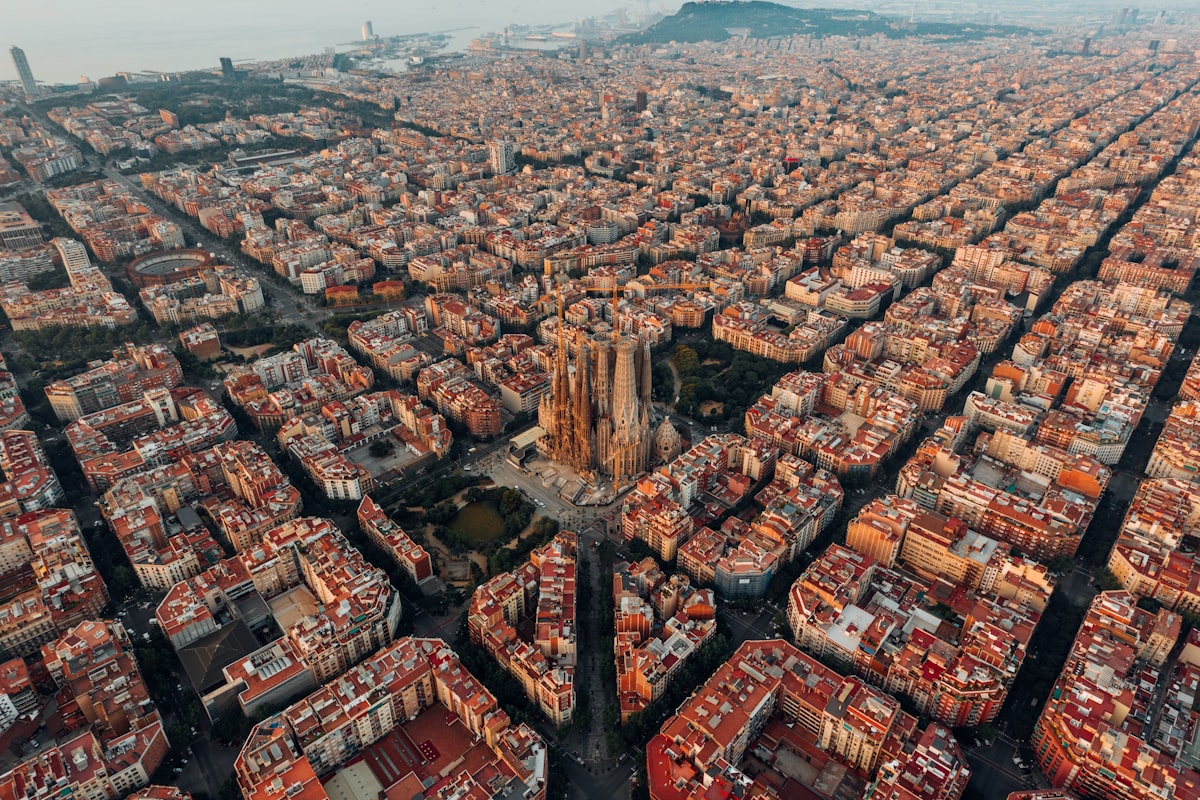
2. Barcelona: Cosmopolitan but Costly
Barcelona (population 1.6 million in the city, 5.5 million in the metro area) is the city that most captures the imagination of aspiring Spain expats — and it delivers on much of that promise. The Gaudí architecture, the beaches, the nightlife, the fashion, the startup ecosystem: it is all real, and it is extraordinary. The price you pay is higher rent, more tourist congestion, and a political backdrop of ongoing Catalan independence sentiment that, while manageable, adds a layer of complexity to daily life.
- •Eixample (Esquerra) — The left side of Barcelona's famous grid neighborhood is popular with young expats and LGBT+ community members. Beautiful modernista buildings, excellent restaurants, central location. 1BR: 1,400–2,000 euros.
- •Gràcia — A village-within-a-city feel, with plazas that fill with locals on summer evenings. More bohemian, slightly more affordable than central Eixample. 1BR: 1,200–1,700 euros.
- •Poblenou — Barcelona's tech district (the "22@ district"), packed with startups and coworking spaces. Newer buildings, close to the beach, popular with digital nomads. 1BR: 1,300–1,800 euros.
- •Sant Gervasi / Sarrià — Quieter, more family-oriented neighborhoods in the upper part of the city. Higher rents but excellent schools and a calmer pace.
Cost snapshot (single person): 2,100–3,000 euros/month Average internet speed: 500 Mbps Estimated English-speaking expat community: 80,000+ registered foreigners, one of the largest American expat communities in Europe Coworking options: 50+ spaces, including major international brands; day passes 20–35 euros, monthly 200–400 euros
Pros: World-class culture and architecture, largest international professional network in Spain, direct transatlantic flights, thriving tech and creative industries, excellent public transportation Cons: Most expensive city in Spain for rent, heavy tourist saturation in central areas, pickpocketing rates higher than other Spanish cities, Catalan language adds complexity for Spanish speakers
3. Madrid: The Capital for Career-Focused Expats
Madrid (population 3.3 million city, 6.7 million metro) is Spain's beating heart — political, economic, and cultural. It lacks Barcelona's beaches and Valencia's laid-back Mediterranean energy, but it more than compensates with an intensity of cultural life and professional opportunity that is hard to find outside the world's largest capitals. The Prado and Reina Sofía museums alone are worth moving to Madrid. Add Retiro Park, the vibrant Malasaña and Lavapiés neighborhoods, and a restaurant scene that has quietly become one of Europe's best, and you have a city that rewards full engagement.
- •Malasaña — Madrid's bohemian district, historically the epicenter of the movida cultural movement, now popular with young professionals, creatives, and expats. Independent bars, record shops, and coffee roasters everywhere. 1BR: 1,100–1,600 euros.
- •Lavapiés — The most multicultural neighborhood in Madrid, with a global food scene and a strong artist community. More affordable than Malasaña. 1BR: 900–1,300 euros.
- •Chamberí — Elegant, residential, and slightly quieter. Popular with professionals and families. Good schools, beautiful architecture, excellent local restaurants. 1BR: 1,300–1,800 euros.
- •Chueca — Madrid's LGBT+ district, lively and welcoming, extremely central. 1BR: 1,200–1,700 euros.
Cost snapshot (single person): 1,900–2,700 euros/month Average internet speed: 480 Mbps Estimated expat community: 600,000+ registered foreigners in the greater Madrid region; substantial American business community Coworking options: 60+ spaces, including Google Campus Madrid; day passes 15–30 euros, monthly 180–380 euros
Pros: Best job market in Spain for Spanish-speaking professionals, unrivaled cultural institutions, excellent international airport, highest density of multinational company offices, central location for European travel Cons: No beach (Valencian coast is a 90-minute AVE ride), hotter and colder weather extremes than coastal cities, slightly more expensive than Valencia or Malaga
4. Malaga: The Rising Star of Southern Spain
Malaga (population 580,000) has undergone a remarkable transformation over the past decade. Once dismissed as a transit city for Costa del Sol tourists, it has reinvented itself as a genuine urban destination: the Pompidou Centre Málaga opened here in 2015, the tech park (Parque Tecnológico de Andalucía) hosts over 600 companies, and a wave of young Spaniards and international remote workers has breathed new life into its historic center and surrounding neighborhoods.
- •Centro Histórico — The revitalized city center, walkable and packed with restaurants, galleries, and street life. Close to the Picasso Museum (Malaga is Picasso's birthplace). 1BR: 800–1,100 euros.
- •Soho — Malaga's arts district, positioned between the port and the city center. Street murals, trendy restaurants, younger demographic. 1BR: 750–1,050 euros.
- •El Palo / Pedregalejo — Beachside neighborhoods east of the center, beloved by locals for their traditional chiringuitos (beach restaurants). More relaxed pace, good value. 1BR: 700–950 euros.
Cost snapshot (single person): 1,350–1,800 euros/month Average internet speed: 380 Mbps Estimated expat community: 25,000+ registered foreigners; large British and growing American community Coworking options: 12+ spaces, day passes 12–20 euros, monthly 130–250 euros
Pros: Best year-round climate in Spain (18°C average in January), most affordable city on this list alongside Seville, fast-growing tech scene, excellent beaches within walking distance of center, Málaga-Costa del Sol Airport with growing international connections Cons: Smaller than Madrid or Barcelona (fewer cultural institutions), public transport less developed than capital cities, slightly smaller English-speaking professional network
5. Seville: The Soul of Spain
Seville (population 690,000) is where many expats who were "just visiting" decide to stay forever. The capital of Andalusia is arguably the most Spanish of all major Spanish cities — the flamenco is real, not performative; the tapas culture is a way of life rather than a tourist attraction; and the sense of community and warmth that Sevillanos extend to newcomers is remarkable. The historic center, with its Alcázar palace, Gothic cathedral, and the Torre del Oro on the Guadalquivir River, is among the most beautiful in Europe.
- •Triana — Across the river from the historic center, traditionally a neighborhood of flamenco artists, ceramicists, and fishermen. Now popular with expats who want to integrate into local life rather than expat bubbles. 1BR: 650–900 euros.
- •El Centro / Barrio Santa Cruz — The historic heart of Seville, beautiful to walk but more tourist-facing. Good for short-term stays; long-term residents often prefer quieter options. 1BR: 750–1,000 euros.
- •Alameda de Hércules — Seville's most progressive and bohemian street, lined with outdoor bars and independent restaurants. Popular with young expats and the arts community. 1BR: 700–950 euros.
Cost snapshot (single person): 1,250–1,700 euros/month Average internet speed: 350 Mbps Estimated expat community: 20,000+ registered foreigners; smaller but tightly knit English-speaking community Coworking options: 8+ spaces, day passes 10–18 euros, monthly 110–200 euros
Pros: Most affordable major city in Spain, most authentic Spanish cultural experience, extraordinary architecture and history, warm and welcoming local community, excellent food and wine Cons: Extremely hot summers (July–August regularly exceed 40°C / 104°F), smaller expat community means fewer ready-made English-speaking social networks, fewer direct international flights than other cities
How to Choose: A Quick Decision Framework
| Priority | Best City |
|---|---|
| Affordability | Seville or Malaga |
| Beach + affordability | Valencia or Malaga |
| Career opportunities | Madrid |
| International community | Barcelona |
| Cultural immersion | Seville |
| Tech / startup scene | Barcelona or Valencia |
| Family-friendly lifestyle | Madrid or Valencia |
| Year-round warm weather | Malaga |
| Best all-around | Valencia |
Not sure which city suits your lifestyle and budget? Use our free quiz to get a personalized recommendation based on your work situation, lifestyle preferences, and budget.
Frequently Asked Questions
Is it easy to make Spanish friends as an expat? Spaniards are warm and social but have established friend groups built over years. The key is to engage in local activities: language exchange meetups (intercambios), local sports clubs, neighborhood association events, and simply being a regular at local bars. Learning Spanish dramatically accelerates the process. Barcelona's large international community makes it easier to find English-speaking social networks; Seville's smaller expat community means more organic integration with locals.
How important is speaking Spanish? It varies by city. Barcelona and Valencia have large English-speaking expat communities and many English-speaking locals. Madrid is less anglophone than the coastal cities but has a growing bilingual professional class. In Seville, functional Spanish is genuinely important for daily life — and also makes the experience far richer. In all cities, even basic conversational Spanish (A2 level) transforms daily interactions.
Are there American schools in Spain? Yes. Madrid has several international and American-curriculum schools, including the American School of Madrid and King's College School. Barcelona has the American School of Barcelona and many British-curriculum international schools. Valencia, Malaga, and Seville have fewer options but do have international schools with English-language instruction.
What is the commute culture like? Spain's walkability, combined with excellent public transport, means most expats in city centers never need a car. Barcelona and Madrid have among the best metro systems in Europe. Most errands, restaurants, and social activities are reachable on foot or by metro within 15 to 30 minutes. This significantly reduces daily friction and cost compared to car-dependent US cities.
Ready to find your path?
Take our 3-minute quiz and get personalized visa and city recommendations.
Check Your Visa Eligibility — Free →